T a k a s h i
 Y
a m a g u c h i
Y
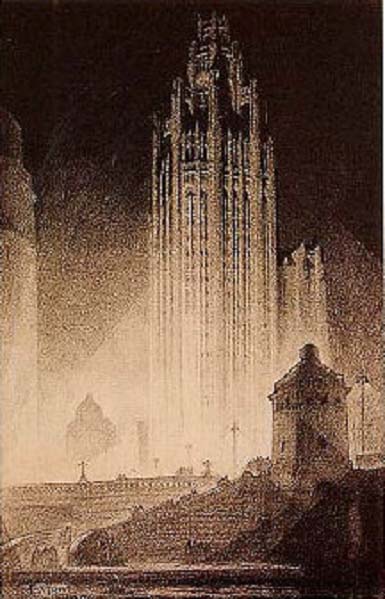
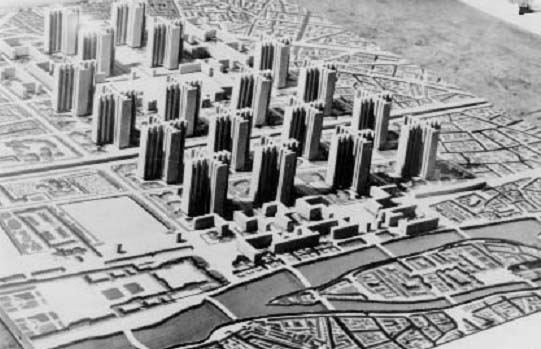
a m a g u c h i In the February 12, 1930 edition of The New Republic, Lewis Mumford reviewed “The City of Tomorrow” by Le Corbusier and “The Metropolis of Tomorrow” by Hugh Ferriss.
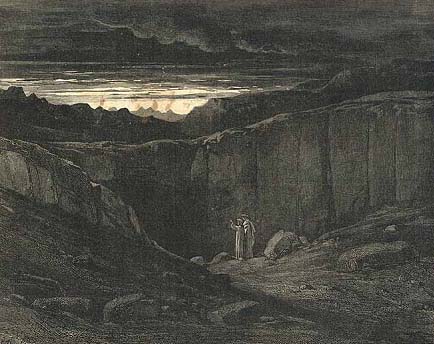
Concerning Ferriss’s use of scientifically unfounded optics in his drawings, which made his buildings appear to shine from earth into the heavens, Mumford was critical. Although this was probably for dramatic effect, he wrote, it showed that Ferriss’s urban vision was little different from Dante’s inferno.
Still, in noting that such optics are in violation of physical laws, did not Mumford himself reveal that his understanding of the modern city was fundamentally lacking? After all, such optics may be impossible in terms of natural light, but what of the artificial light of the city at night? Viewed from this perspective, the city Ferriss described in his drawings is, indeed, the image of the contemporary city.
Ferriss conducted research, asking himself what architectural styles might be possible under regional zoning laws enacted in New York in 1916. As his answer, he came up with the setback style of skyscraper.
New York’s zoning laws were characterized by two points: First, building floor area was regulated in terms of site area. Next, each successive floor had to have a smaller area, as the building rose higher in elevation. This was because high-rise buildings rising straight from total site area blocked sunlight from falling on roads and neighboring buildings, while inviting urban density and deteriorating conditions. Until then, skyscrapers had employed a so-called box structure, rising in a straight line from the plan, with a spire at the top. The new zoning laws therefore rendered conventional skyscraper design methods obsolete.
Through his research, however, Ferriss was able to bring a positive light to the darkness of the zoning laws. He discovered that if you created the building that was possible under the full limits of the laws, it produced a tower of slender, pyramid-like shape. Hence, he proposed the so-called setback method, carving the building back to a stepped volume that grew progressively thinner at regular fixed heights.
If the rationalism of Le Corbusier, at this time, aimed for the utopia of a city permeated by the light of modern logic----the symbolic city----and if expressionist architects such as Bruno Taut aimed for a nostalgic utopia, founded on their yearning for the past----the imaginary city----then what Ferriss proposed is considered a rational attempt to address the reality of the city, in accord with existing conditions in New York, which was building many skyscrapers.
When a people lose their common vision of society’s direction, then all concrete images of utopia are also lost. At such a time, history tells us, man responds to the chaos of the city by moving either toward preservation, based on nostalgia for the natural or technological landscape of the past, or else toward an order imposed by geometry.
Utopians who reject reality and seek to reorder the world by means of their own ideas inevitably sing praises of city spaces ordered by geometry. Even Ferriss, who, we might expect, took the energy of the city as his point of departure, could not escape this kind of utopian illness. Ironically, Ferriss came to envision a new geometric utopia taking the skyscraper as its icon.
For modern logic, which seeks to construct the world through human intervention, the most powerful, conveniently available icon is geometry. This means, in other words, the reconstruction of Eden or return to Eden----a revisit to the impotent dream of alchemy.
A retrogression to the glorification of symbol and to a primeval beginning existing only in the imagination.
Could it be possible for us to escape the seduction of these backward-looking visions? On the other hand, might we also avoid singing simple praises for chaos?
In “The Baroque Arsenal,” author Mary Kaldor discusses the Kondratiev cycle----or long wave of economic prosperity occurring in the arms industry. The cause of this cycle, she explains, is the over-sophistication of products and production systems, which are given excessive functions or built oversized in order to produce new purchasing incentives.
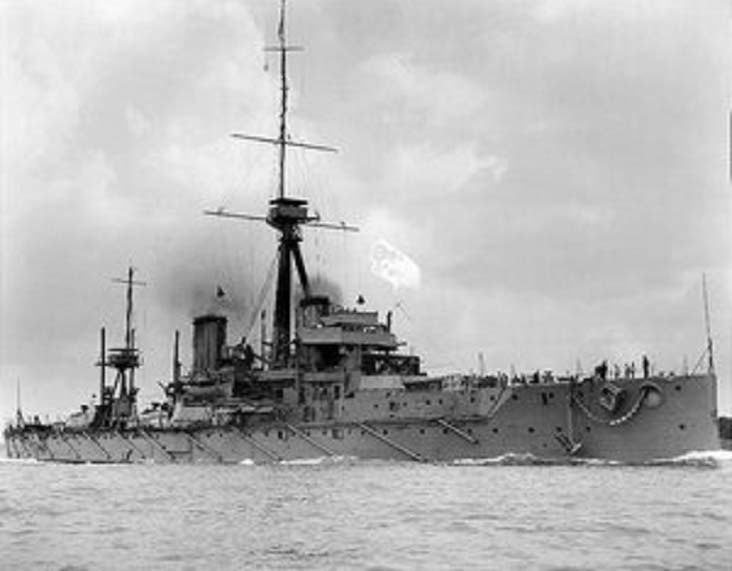
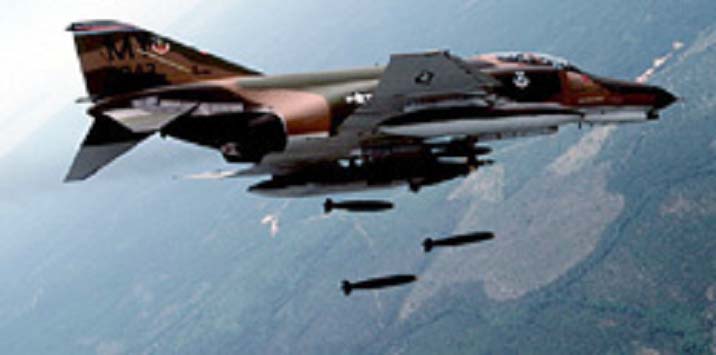
As good examples of “baroque” military technology, Kaldor discusses the monstrously oversized “Dreadnought” battleships of the late 19th century and the over-sophistication and over-sizing of American jet fighters occurring in the 1960s and 70s.
The over-sophistication of electric fans, microwave ovens, and other functionally complete household appliances by giving them unimportant functions in great numbers is another example of baroque technology.
In other words, once a key industry matures, it can continue to control the market even after sales flatten out by improving unimportant product details or adding nearly useless functions. It can do this because it is the dominant industry. Such extravagance is the mark of a baroque industry.
Still, because capitalism is founded on growth, there is a limit to how long this form of market economy can be maintained. Hence, a panic inevitably occurs and the key industry declines. Thereafter, a new key industry is selected, and a new cycle begins.
What is important, here, is that nothing new will ever come forth from a baroque industry that can only repeatedly exercise this principle of control, in the context of the existing system, by producing a succession of minor differences.
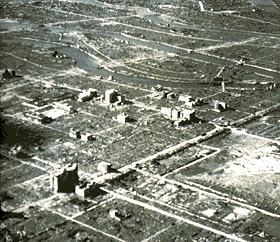
Most Japanese cities were burnt to the ground in air raids during World War II and had to rebuild from nothing. This meant starting from a blank in terms of traditional, classical city structures. In places where the link with the past was very thin, today’s “excessive city” has developed and flourished.
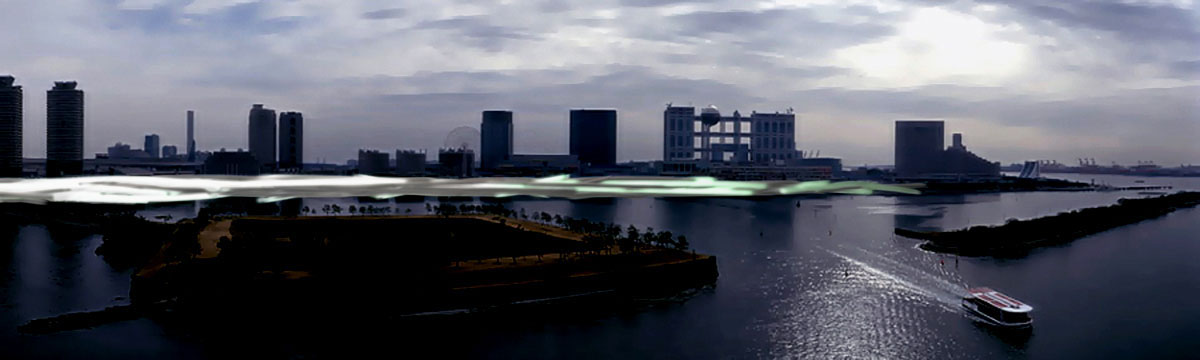
Tokyo has clearly cut itself off from its past. This city which extends without variation, in all directions, is truly a result of baroque production and extravagance. Here, we find no geometric utopia. Countless devices, satisfying the entire spectrum of desire, are complexly interwoven in the city fabric. We cannot see the overall figure of Tokyo but only its parts. Tokyo-----a city that grows freely, as it will, horizontally and vertically; an urban monster. In such a city, individual pieces of architecture cannot possibly provide solutions. Individual buildings simply embody the baroque extravagance and produce more baroque production, adding to the urban chaos and hastening the city’s deterioration.
The urban channels moving fluidly through the city let us to feel the dynamic energy of the city. Such channels can potentially disperse and neutralize urban desire. I am currently interested in fluid forms---- architecture that flows rather than square architecture of vertical rise. Fluid architecture expresses direction and makes us conscious of time. Bundled fluid forms have the power to absorb the all and everything.
Our contemporary cities can only expand along a horizontal or vertical axis. Chaos results because these two axes cannot sufficiently accommodate the city’s energy. To this urban condition, let us give a warping axis. By providing fluid, continuous spaces this will be a means for the city to make a new departure and discover new meaning----a means to evolve in a new direction, while yet maintaining connection with the past.
These channels or openings in the urban fabric can potentially take us outside the harsh defining edges of the abhorrent horizontal and vertical logic and functionality that control us. In this sense, railways have important meaning. Railways already display to us an edgeless fluid form not possible to create in architecture. Such channels provide openings in urban time and urban places.
In the new city structure, these channels will be seen to transcend their figure-ground relationship with the city. By means of the magnetic field they produce, these flowing channels have huge potential to transform and vitalize the urban structure.
Architects have long sought to place architecture in a suitable relationship of harmony with its place, but such a relationship is less and less possible, no matter how we may desire it. As the cause of this, I will cite the weakening relationship between architecture and place, in our times.
Today, architecture no longer enjoys a clear relationship with its place. The word “context” is losing its meaning. The speed and acceleration that promote technology’s integration with urban networks are demanding that architecture change in its essential character.
There is growing need for architecture that has city scale, instead of small units of architecture which collectively form the city. Architecture, today, looks beyond such small units, seeking height, expansion and warping flow. In the past, large-scale architecture was limited to buildings that housed authority, such as palaces and temples. Today, however, our everyday spaces are also growing massive in scale, the more they are fed by human desire. Stations, offices, commercial facilities----such facilities are being combined in complex, large-scale buildings. Such buildings are born from the fundamental principles of capitalism: cost, draw, convenience, profitability, and efficiency. In the past, architecture came into being from its relationship with its surroundings. “Near” and “far” had a clear hierarchy, and context ranked highest in importance. Architecture derived its being from the elements of its context.
Today, however, this hierarchy is collapsing. “Near” no longer enjoys absolute dominance over “far.” This is because excessive human desire under capitalism, a feature of modern civilization, has destroyed the solid relationship between architecture and place, and seeks a distorted relationship with place. Due to accelerated urban networks, “far” and “near” have become reversible, and they enjoy interconnection within that reversal of position. This invisible energy distorts the potential of the city. Naturally, architecture too must change in order to contain such energy. In direction, this irregular energy seeks acceleration, and this promotes the fluidization of space, all the more. Architecture must accordingly change in character from a hard vessel containing regular functions to a soft, adaptable organ, receptive to such irregular, fluid energy.
Particles coming and going in a fluid, interior energy, liberated from structure and having neither form nor image. This energy flows dynamically, simply pursuing the direction and vector its momentum; and architecture must receive it without subdividing into compartments.
Telecommunications enable the instantaneous movement of information and physical matter, beyond the limitations of distance. There is unmediated movement between places, transcending space. This takes actual form in high-speed networks or jet transportation networks, or else laser beams; weapons that transcend space and destroy the enemy instantaneously.
In such times, a new architecture will not be forthcoming, unless we cease both to look back to lofty aesthetics of 18th and 19th century origin and to deny the value of futuristic aesthetics.
Until now, architecture has rejected fluidity and continuousness. This has been due more to restrictions on human thinking than to structural limitations. Space, we have generally agreed, envelops us and is limited or restricted by walls. In our narrow thinking, we have seen spaces and buildings as delineated by a rigid outline. Yet, with the development of cyber-technology, these views are now being challenged. There is increasing need for architecture to obtain fluidity and interiority.
Through advances in computer network technology, physical space and electronic space are becoming united, and the dichotomy of “idea versus “reality” is being overturned and made invalid. This fact will alter actual human experience and activity in everyday space. This pliant new technology is converging the world in a new dimension that reconciles differences between the corporeal and the incorporeal.
Humans too are beginning to cast off the physical environment enveloping them, as they construct a new, incorporeal framework. The new media are enveloping our being, much as space envelops our bodies, and are gradually taking on the functions of a skin. In substance, architecture moves infinitely closer in character to an outer skin. We are becoming interiorized by this outer skin layer. Architecture, in other words, will become media-like in character. Architecture will no longer be able to serve human needs using old methods of sectionalization.
Our highly physical society has been overly discontinuous, until now. Our architecture, too, has been articulated and discontinuous----an isolated being. The aspirations behind architectural form, in other words, have made a fetish of the building contour. As our world grows increasingly fluid, however, and things become continuousness, the existence of contours will be rejected. Contours, after all, serve to regulate and restrict the forms of things.
Our newly appearing cyber-technology will envelop people and habitat and surround the world like a nerve system, so that de-centering occurs in places everywhere. This pliant form of space, even while working in conjunction with the physical space of reality, exists in a slightly separate reality, and has a fluid, non-geometric character.
This means the creation of sympathetic spaces transcending the dichotomy of “virtual versus physical.” As much as these two different kinds of space envelope our being, it will be necessary for us to blend them, without regarding them as separate, and give them intersection in three dimensions.
Poiesis or in other words, architectural creation, is an act of breaking down the totality of elements that exist in a place, in order to reunite those elements in a world of new meaning. When inserted in its place, the new architecture transforms the existing meaning with its presence. In fact, the history of architecture is nothing more than an endlessly evolving repetition of such reunification.
Architectural thinking means to contemplate all human actions. Architectural thinking is a philosophy reflecting my own values concerning how people should live. The built architecture is nothing else than a crystallization of this thinking. Thought takes form as image; its figure is visually expressed. An image is simply an image and doesn't exist in reality; yet when an image becomes a vision, it obtains an awesome power to transform reality.
The framework of spatial concepts
engendered by modernism can no longer contain the fluid, chaotic energy
of contemporary society. The rapid evolution of speed and acceleration
as attributes of our society is transforming the nature of our spaces.
Grid-generated
forms are losing their applicability to spatial needs. As long as society
moves in the vector of excess, a defining element of contemporary culture,
these attributes will evolve at a quickening pace. Within the interplay
of ecriture, a flowing energy transcending border or delineation obtains
speed and acceleration and shrinks distances.
To recognize the chaotic reality. To tame the unknown future. To create without clinging to past icons and without false vision. All are important, in my belief.
How will we address the chaotic city? Through discussion and reasoning, will we be able to stand astride the currents of change and accomplish the new utopia?
We, acting in the fleeting
“now” between past and future, must ponder: What is needed to replenish
the present?
[ Capital Theatre in Beijing : ABB Forum; Cracking Puzzeles in China
]